1300 70 13 14
PM-Partners
  • Services

    Training and Capability uplift
    Advisory
    Agile
    Scaled Agile (SAFe®)
    Delivery
    Resourcing
    PM-Digital
    Hire an expert

    Recent case studies

    View all case studies

    world map with silhouettes of people in the background

    Shifting from a programme to a solution model through SAFe® to drive CX ecosystem stability

    businessman in suit looking at futuristic tech dashboard against cityscape

    From data to insights: A Power BI dashboard for FOSS component management

    • Training and Capability uplift
    • Advisory
    • Agile
    • Scaled Agile (SAFe®)
    • Delivery
    • Resourcing
    • PM-Digital
    • Hire an expert
  • Industries

    Government
    Higher education
    Construction
    Financial services
    Energy and utilities
    Healthcare and pharma

    Featured case study

    View all case studies

    Two workers in a warehouse holding digital tablet with hardhat and safety vest

    PM-Partners helps Downer set new industry standards for project management workforce development with award-winning ‘Project Plus’ initiative.

    LEARN MORE

    • Government
    • Higher education
    • Construction
    • Financial services
    • Energy and utilities
    • Healthcare and pharma
    • Case studies
  • Resources

    Insights
    Case studies
    Complexity assessment
    Capability hub
    Knowledge hub
    eBooks and white papers
    Checklists and infographics

    Featured insight

    View all insights

    5trends-2026

    Five emerging trends shaping project and change management capability in 2026

    LEARN MORE

    • Insights
    • Case studies
    • Complexity assessment
    • Capability hub
    • Knowledge Hub
    • eBooks & white papers
    • Checklists and infographics
  • About

    What we do
    Who we are
    Leadership team
    Join the team
    Our beliefs
    Our partners

    Upcoming events

    View all events

    • Events
    • What we do
    • Who we are
    • Leadership team
    • Join the team
    • Our beliefs
    • Our partners
  • Contact us
  • Training Courses
    • Promotions & special offers
    • Course list
    • Course Calendar
    • Group bookings
    • In-house training
    • Capability uplift
    • Training catalogue

    Popular pages

    AI courses
    Hybrid classroom
    Learning pathways
    Room hire
    Meet our trainers
    eLearning courses
    Power skills courses
    Level Up

    Popular courses

    View all courses

    AI-Native Foundations
    AI-Native Change Agent
    Scrum Master Certified (SMC®)
    Agile Project Management
    PRINCE2®
    Project Management Fundamentals
    Business Analysis Fundamentals
    Running an effective Hybrid PMO

    • Promotions and special offers
    • Course list
    • Course calendar
    • Group bookings
    • In house training
    • Capability uplift
    • Training catalogue
    • POPULAR PAGES
    • AI Courses
    • Hybrid classroom
    • Learning pathways
    • Room hire
    • Meet our trainers
    • eLearning courses
    • Power skills Courses
    • Power Match
    • POPULAR COURSES
    • Scrum Master Certified (SMC®)
    • Agile Project Management
    • PRINCE2®
    • Project Management Fundamentals
    • Business Analysis Fundamentals
    • Running an Effective Hybrid PMO
  • No products in cart.
  • Home
  • Learning and Development
  • Why AI is a leadership opportunity, not a workforce threat
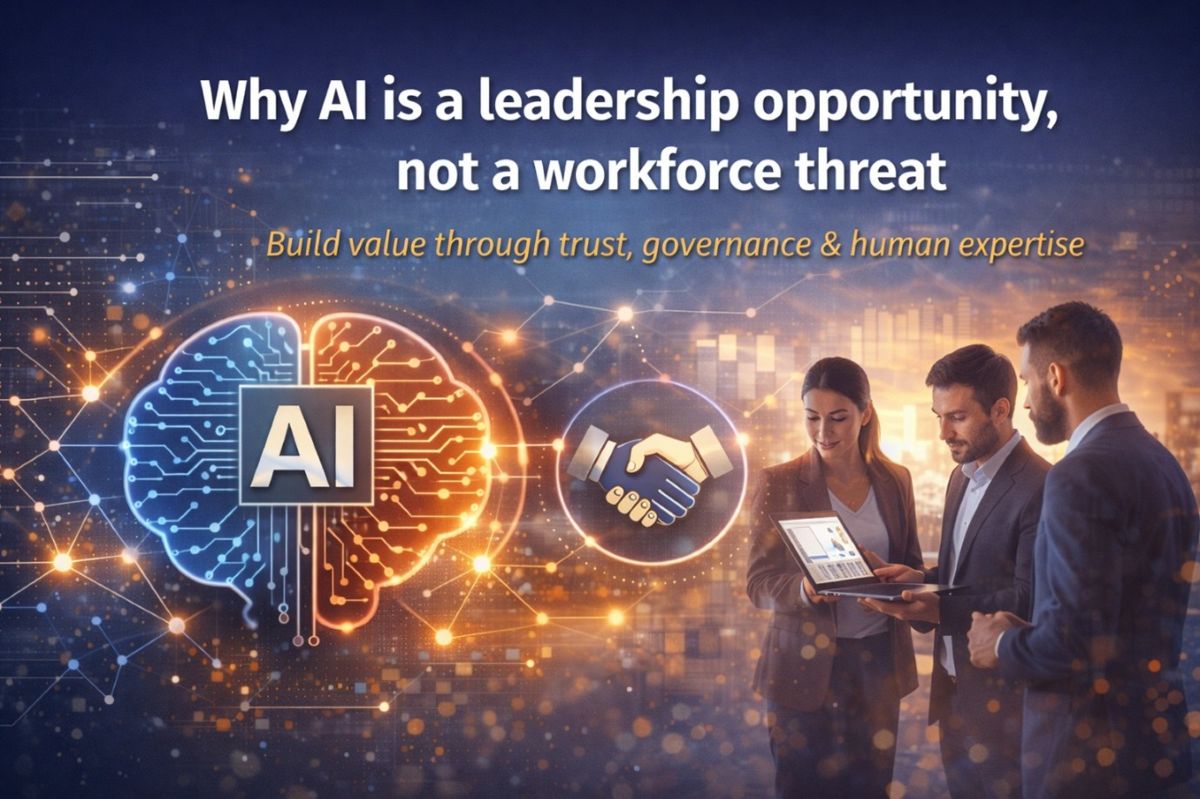
January 28, 2026

Why AI is a leadership opportunity, not a workforce threat

Why AI is a leadership opportunity, not a workforce threat

Wednesday, 28 January 2026 / Published in Learning and Development
Why AI is a leadership opportunity, not a workforce threat

How AI has been perceived in recent years

In 2025, against a backdrop of workforce reductions and efficiency pressures, artificial intelligence was often perceived as a threat. For many professionals, AI became associated with job displacement or the expectation that fewer people would be required to do more work.

This framing, however, misses a more practical and constructive opportunity. AI is not replacing thoughtful work. It is reshaping how work gets done, enabling organisations to operate smarter rather than simply harder. When approached strategically, AI can increase productivity, reduce risk, and strengthen decision-making, while keeping people firmly at the centre of the ecosystem.

AI as an augmentation tool, not a replacement

The real opportunity lies in treating AI as a partner rather than a substitute. AI excels at analysing large volumes of data, identifying repeatable patterns, automating routine tasks, and accelerating research and synthesis.

This creates space for professionals to focus on higher-value work, such as strategy, judgement, creativity, and relationship building. In this model, AI acts as a co-pilot, supporting decision-making while human experience, context, and accountability remain essential.

Where the real risks with AI actually sit

Realising this opportunity requires discipline. The greatest risks associated with AI today are not jobs. They are data accuracy, source reliability, and information security.

AI systems are only as effective as the data they rely on and the prompts they are given. Inaccurate inputs, biased sources, or unsecured data can result in flawed insights, reputational damage, or unintended disclosure of sensitive information. These risks are already well documented across industries.

Why AI governance must be a core capability

To mitigate these risks, AI governance must be treated as a core organisational capability rather than an afterthought. This includes establishing clear rules and accountability for how AI is used and how its outputs are interpreted.

Effective AI governance typically includes:

  • Clear guidelines on what data can and cannot be used
  • Validation of sources used in AI-generated outputs
  • Training employees to question and verify results rather than accept them at face value
  • Ensuring AI tools meet enterprise security and compliance standards
  • Assigning ownership, often through functions such as a PMO, to ensure governance is consistently applied

AI as a risk-reduction tool when implemented responsibly

When implemented with strong data stewardship and human oversight, AI becomes a risk-reduction tool rather than a risk multiplier. It can improve consistency, surface errors earlier, and increase transparency in decision-making.

Used responsibly, AI supports better outcomes by reinforcing good judgement, not bypassing it.

The leadership opportunity AI presents

The organisations that succeed with AI will not be those that replace people the fastest. They will be the ones that combine human expertise, high-quality data, and trusted sources to make better decisions at scale.

AI is not a job risk. It is a leadership opportunity, one that rewards organisations that invest in governance, capability, and trust alongside technology.

Building this level of AI capability does not happen by accident. It requires leaders and teams to develop a shared understanding of how AI works, where its risks sit, and how it can be applied responsibly in real delivery environments. This is why organisations increasingly invest in structured AI education, such as PM-Partners’ AI and AI-Native training programs, to build confidence, governance, and practical decision-making capability.

Quinn Dodsworth pm partners

About The Author

Quinn Dodsworth

Agile Learning Consultant and Facilitator at PM-Partners

Quinn is a highly capable manager with a solid Agile transformation background backed by a human resource learning and development education. His industry experience includes seven years with the Commonwealth Bank of Australia and the Westpac Group specialising in change and productivity initiatives within various Agile transformations that underpin business learning and market demand.

Quinn’s focus is on driving new and innovative solutions to uplift business capability through the design and development of critical skills and knowledge across an organisation. These projects can range in size and complexity, with multiple internal and external stakeholders engaged to deliver a range of learning solutions to assist in Agile transformation.

What you can read next

Colleagues in the meeting room standing by the kanban wall
L&D advisory
Puzzle pieces
How can I integrate PRINCE2® into my organisation?
managing successful programmes pm-partners
Managing Successful Programmes (MSP®) – what’s new in the 5th edition?

GENERAL ENQUIRY
1300 70 13 14

CONTACT US
Send a message

FOLLOW US

  • LinkedIn logo
  • X logo
  • Facebook logo
  • Instagram logo
Partner logos

PM-Partners group is a Project Management Institute (PMI)® – Premier Authorised Training Partner (ATP) (ID: 1394), an APMG-International Accredited Training Organisation (ATO), a Gold partner of PeopleCert (Partner ID: 3800), an Endorsed Education Provider™ (EEP™) of International Institute for Business Analysis™ (IIBA®), a Scaled Agile Gold Partner, an ICAgile Member Organisation, a GPM Accredited Training Partner, and a Microsoft® EPM Solution Partner. PMI, CAPM, Certified Associate in Project Management (CAPM), PMP, Project Management Professional (PMP), PMI Agile Certified Practitioner (PMI-ACP) and PMBOK are registered marks of the Project Management Institute, Inc. Provider is a member of the PMI ATP Program. PMI does not specifically endorse, approve, or warrant ATP’s products, courses, publications, or services. The PMI ATP seal is a registered mark of the Project Management Institute, Inc. PRINCE2®, AgileSHIFT®, MSP®, P3O®, MoP®, ITIL® , PRINCE2 Agile®, DEVOPS INSTITUTE® and DEVOPS FOUNDATION® are registered trademarks of the PeopleCert group. Used under licence from PeopleCert. All rights reserved. AgilePM®, AgilePgM®, AgileBA® and DSDM® are registered trademarks of Agile Business Consortium Limited. All rights reserved. APMG International Change Management, APMG International Lean Six Sigma are trademarks of The APM Group Limited. All rights reserved. The APMG-International, APMG-International AgilePM, AgilePgM, AgileBA, Change Management, Managing Benefits, Lean Six Sigma and Swirl Device logos are trademarks of The APM Group Limited, used under permission of The APM Group Limited. All rights reserved. SMC® and SPOC® are trademarks of SCRUMstudy. Scaled Agile Framework® and SAFe® are registered trade marks of Scaled Agile, Inc.

IIBA®, the IIBA® logo, BABOK® Guide, Business Analysis Body of Knowledge®, Business Analysis Core Concept Model™, BACCM™ are (registered) trademarks owned by International Institute of Business Analysis. Entry Certificate in Business Analysis™, ECBA™, Certified Business Analysis Professional™, CBAP®, Certification of Capability in Business Analysis™ and CCBA® are (registered) certification marks owned by International Institute of Business Analysis. These trademarks, logos and certification marks are used with the express permission of International Institute of Business Analysis.

House of PMO Essentials for PMO Administrators™ and House of PMO Essentials for PMO Analysts™ are trademarks of House of PMO Limited. All rights reserved. Praxis Framework™ is a trademark of Praxis Framework Limited. ICAgile is a registered trade mark of the International Consortium for Agile. GPM® and Green Project Management® are Registered Trademarks of GPM Global ©Copyright GPM Global 2022. www.greenprojectmanagement.org. ©PRiSM™ is used with consent.

Privacy Policy | Sitemap | Timesheets | Terms & Conditions | Capability Hub | Student & Graduate Pathway
Copyright © 1996-2026 PM-Partners Group. Delivery Advisory Capability. All Rights Reserved.

TOP