


Your AI problem isn’t a technology problem. It’s a people problem.
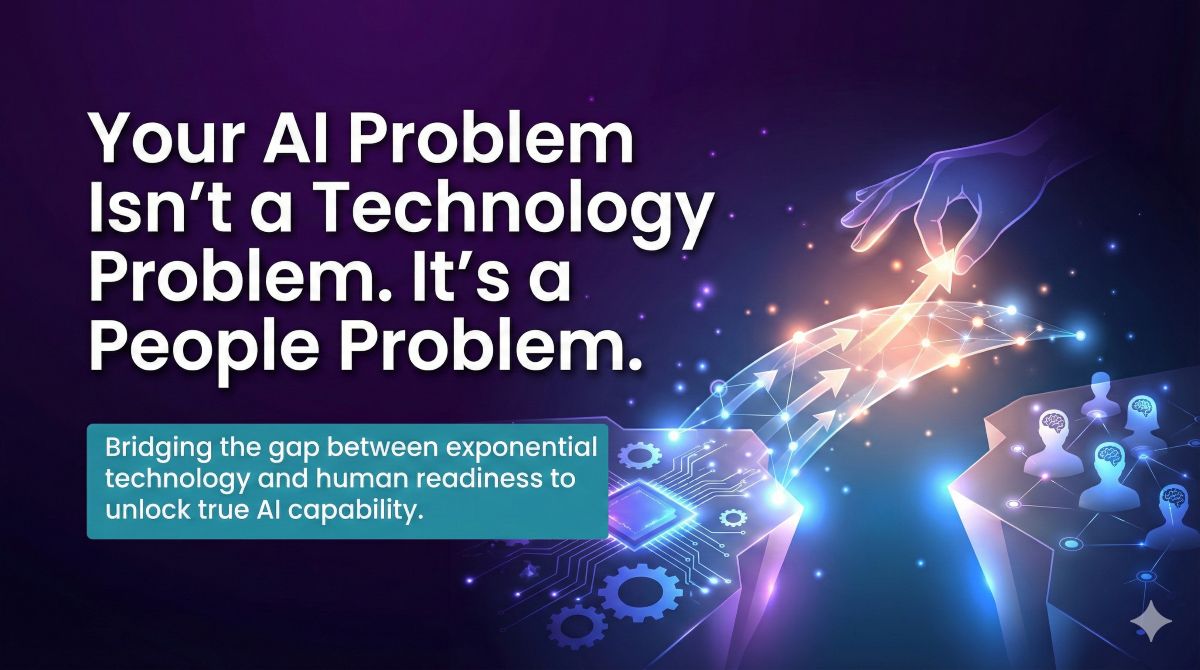
And until organisations address that distinction, the investment gap will keep widening, no matter how much they spend on tools.
Recent global research indicates that organisations are allocating the vast majority of their AI budgets to technology, while only a small proportion is invested in the people expected to use it.
The evidence is clear
McKinsey’s 2025 ‘Superagency in the Workplace’ report is unambiguous: employees are ready for AI. The biggest barrier to AI adoption is that leaders and CIOs treat AI as a technology issue to solve, and not through a human-centered lens. Meanwhile, Prosci’s research across 1,107 professionals found that 63% of organisations cite human factors as the primary challenge in AI implementation.
A widening gap: exponential technology, linear organisations
AI capability is improving exponentially. New models and applications are arriving faster than most organisations can absorb. Organisations, on the other hand, change slowly. People learn incrementally, build confidence through experience, and resist change when it feels unclear. The result is a gap that grows wider every quarter, resulting in AI racing forward while organisational readiness inches along behind it.
McKinsey found that while nearly nine in ten organisations use AI regularly, only 1% describe their deployment as mature. The technology has arrived. The human infrastructure to support it has not. And traditional capability-building approaches, which are designed for gradual change, were never built for this pace. The goal can’t be to close the gap once. It must be to build organisations that keep closing it, continuously.
What ignoring people actually costs
Despite rising access to AI tools, overall workplace usage has dropped by 15% (Deloitte TrustID, 2025). Up to 90% of organisations have staff using unapproved AI tools, creating serious security and governance risks. Trust in generative AI fell 38% in just two months. But workers who received hands-on training reported 144% higher trust than those who didn’t. The fix is clear and it has nothing to do with better software and technology tools.
Where AI-Native Foundations fits in
PM-Partners’ AI-Native Foundations program is built for exactly this challenge. Over two immersive days, teams build the shared vocabulary, judgment skills, and workflow redesign capability that actually drive adoption. Critically, it focuses on adaptive thinking, the mental models that stay relevant as AI keeps evolving, not just today’s tools. Participants leave with a 30-60-90 day action plan ready to implement from day one.
The organisations that win with AI won’t be the ones with the best technology. They’ll be the ones with the most capable, confident people.
You can’t outrun exponential change by standing still. But you can build an organisation that’s capable enough to keep pace. That starts with your people — and it starts with AI-Native Foundations.
Ready to build an AI-Native organisation? Contact us online or call 1300 70 13 14.
Sources: Deloitte Tech Trends Report 2025 (Bill Briggs, CTO); McKinsey ‘Superagency in the Workplace’, January 2025; McKinsey ‘State of AI 2025’; Prosci ‘Keys to Unlocking AI Adoption’; Deloitte TrustID Report Q3 2025; Gartner Hype Cycle for Artificial Intelligence 2025.

Craig is a former CEO and AI strategist who transforms how organizations adopt artificial intelligence. With 20+ years delivering consulting and training globally, he guides boards and leadership teams from AI experimentation to practical, value-driven implementation. Craig's human-centered approach integrates AI strategy, governance, operating models, and people development, all while protecting core business and unlocking innovation. He equips leaders with frameworks for confident AI decision-making and clear execution pathways. Specializing in AI strategy, organizational change, and emotionally intelligent leadership, Craig partners with executives ready to harness AI's potential while keeping people at the centre of transformation.
