


What is Scrum? An overview of Scrum and The Agile Journey
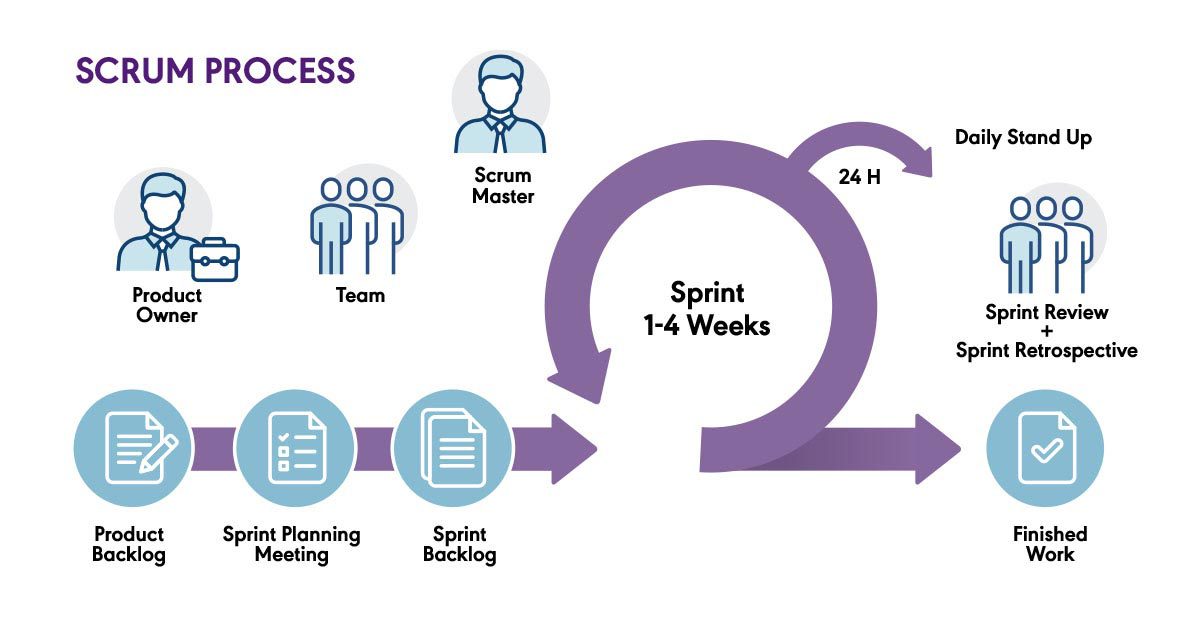
In the third instalment of The Agile Journey, we explore what Scrum is and how it works, including some of the key processes and terms that come into play when putting Scrum into practice.
TL;DR
- Scrum is a lightweight agile framework for delivering complex work in short, fixed-length cycles called Sprints, each one month or less.
- A Scrum team has three accountabilities: a Product Owner, a Scrum Master and Developers. It is typically 10 or fewer people.
- Work flows through five events (the Sprint, Sprint Planning, the Daily Scrum, the Sprint Review and the Sprint Retrospective) and three artefacts (the Product Backlog, the Sprint Backlog and the Increment).
- Agile is a set of values and principles. Scrum is one framework for putting them into practice.
- The Scrum Guide is the official definition, and the best place to start.
What is Scrum?
Scrum is a lightweight agile framework that helps a small, cross-functional team deliver complex work in short, fixed-length cycles called Sprints, each one month or less. In every Sprint, the team plans the work, builds a usable Increment, reviews it with stakeholders, and reflects on how to improve before the next Sprint begins.
Its official definition can be found in the Scrum Guide (written by the creators of Scrum), but in a nutshell, Scrum describes a set of values, tools, and techniques that help teams structure and manage their work to generate value. It uses an iterative, incremental approach when delivering products to optimise predictability and control risk.
In practice, this sees a small cross-functional team – the Scrum team – working collaboratively on bite-sized pieces of work at a time. Each piece is completed within a time-boxed period known as a ‘sprint’, with a focus on learning and improving along the way.
The term ‘Scrum’ originates from a 1986 Harvard Business Review article and an analogy made by the authors comparing high-performing, cross-functional teams to the scrum formation used by rugby teams. While originally designed for software development projects, Scrum is now used in many environments and is one of the most widely used agile frameworks.
Scrum theory
Scrum is built on the theory of empiricism, where knowledge comes from experience and decisions are based on information available at the time.
There are three pillars that support the theory of empiricism:
- Transparency: Key aspects of the process must be visible to those responsible for the outcome.
- Inspection: Timely and frequent inspections take place to detect unwanted variances.
- Adaptation: Unacceptable variances trigger a change in the process to minimise further deviation.
This approach supports the concept of working iteratively. Ultimately, it’s about embracing an experimental mindset; learning and adapting through each cycle of work.
Scrum values
Empiricism and its three pillars are underpinned by five Scrum values.

The 5 Scrum values
- Commitment – the Scrum team commits to supporting each other and achieving the team’s goals.
- Courage – team members have the courage to tackle tough problems and do the right thing.
- Focus – they focus on the work of the Sprint to make the best progress towards their goals.
- Openness – the team and its stakeholders are open about the work and the challenges they face.
- Respect – team members recognise one another as capable, independent people. In turn, they are perceived and respected as such by their co-workers.
The idea is that working consistently with the courage to learn and adapt helps foster a culture of continuous improvement and trust.
Scrum processes
In essence, Scrum tools and techniques allow for large tasks to be broken down into manageable chunks that can be completed in short cycles – sprints – of one month or less.
The main aim of the Scrum process is to deliver value to the customer early and continuously throughout the project’s lifecycle. To this end, those features and product increments that provide the most value for the customer are ordered so that they are developed and delivered first.
To facilitate this process, the Scrum framework relies on the Scrum team and its accountabilities, artefacts, and events, and typically uses a visual representation of the workflow to keep all team members in the loop on WIP and what’s to come. These elements collectively enable the execution of projects with agility and effectiveness.
Scrum team – The Scrum team is a small, self-managing, cross-functional team consisting of a Scrum Master, a Product Owner, and Developers. Between them, they are accountable for delivering an increment of valuable work during a sprint.
Artefacts – Artefacts refer to key information the team uses to define the product and work to be done, such as product backlog, sprint backlog, and product increment (see terminology below), and provide visibility into the development process and progress being made.
Events – Events (often called ceremonies) are the prescribed meetings that ensure everyone is on the same page regarding goals, progress, and improvements. They include the Sprint itself, sprint planning, the Daily Scrum (daily stand-up), sprint reviews, and sprint retrospectives (see terminology below).
By promoting transparency, collaboration, and adaptability, these interrelated components help the Scrum team do their job. Together, they enable the team to plan, execute, and inspect their work, leading to continuous improvement and the delivery of high-quality products that meet stakeholders’ needs.
Scrum at a glance
The Scrum Guide sets out three accountabilities, five events and three artefacts. Each artefact also carries a commitment that gives the team a clear target.
| Element | What it is | Key detail |
|---|---|---|
| Accountabilities | ||
| Product Owner | Maximises the value of the team’s work | Owns and orders the Product Backlog |
| Scrum Master | Establishes Scrum and helps the team improve | Coaches the team and removes impediments |
| Developers | Create a usable Increment each Sprint | Plan and manage their own Sprint work |
| Events | ||
| Sprint | The container for all other events | One month or less |
| Sprint Planning | Agrees what the Sprint will deliver and how | Up to 8 hours for a one-month Sprint |
| Daily Scrum | Inspects progress towards the Sprint Goal | 15 minutes |
| Sprint Review | Inspects the outcome with stakeholders | Up to 4 hours for a one-month Sprint |
| Sprint Retrospective | Plans ways to improve quality and effectiveness | Up to 3 hours for a one-month Sprint |
| Artefacts and commitments | ||
| Product Backlog | The ordered list of what is needed to improve the product | Commitment: Product Goal |
| Sprint Backlog | The Sprint Goal, selected items and a delivery plan | Commitment: Sprint Goal |
| Increment | A usable step towards the Product Goal | Commitment: Definition of Done |
Shorter Sprints use proportionally shorter timeboxes for planning, review and retrospective.
Agile versus Scrum
Scrum and agile are often mistakenly thought of as the same thing. Agile is a collection of principles and values that stress flexibility and collaboration, formalised in 2001 through the Agile Manifesto (as a response to the limitations of traditional project management). Scrum, on the other hand, is a particular framework (often loosely called a methodology) used to apply these principles, focusing on transparency, inspection, and adaption. Further, agile principles can be interpreted and used in various ways; Scrum – although flexible – offers a more prescriptive structure with defined accountabilities and events.

| Agile | Scrum | |
|---|---|---|
| What it is | A mindset: four values and 12 principles | A framework that applies agile values and principles |
| Defined by | The Agile Manifesto (2001) | The Scrum Guide (2020) |
| Structure | No prescribed roles or meetings | 3 accountabilities, 5 events, 3 artefacts |
| Scope | Applies to any team or way of working | Best suited to complex work done in Sprints |
For a side-by-side look at agile, Scrum and scaled frameworks such as SAFe®, see our full comparison guide.
There are a number of other agile frameworks to choose from: Kanban or Lean, for example. But it’s safe to say that Scrum is today’s agile project management framework of choice. This is particularly the case when it comes to completing complex projects in dynamic conditions. Whichever framework you select you will still be adhering to standard agile principles and using standard agile practices, it’s just that the tools, techniques, and terminology you employ to ‘do agile’ will vary.
The most important thing to remember is that the right frameworks and processes are just the beginning. Yes, these can enable organisations to start building agile principles and practices into their everyday work, but experiencing the full benefits of agile entails a mindset shift at all levels of the organisation. It’s about empowering everyone with behaviours that fundamentally change the way they think about delivering value to customers.
Scrum terminology
As with all things project management, there’s no shortage of terminology when working in Scrum agile. As you familiarise yourself with the framework, here are some of the key terms you will come across:
Backlog – a prioritised (ordered) list of everything that might be developed in a product or service and the single source of work undertaken by the Scrum team. The list is typically made up of user stories (see below), describing who wants the feature and why.
Product Goal – the long-term objective for the product. It is the commitment for the Product Backlog, and the Scrum team works towards one Product Goal at a time.
Sprint – a fixed timeframe (usually two weeks) that is repeatedly used to deliver selected features from the backlog. The objective is to produce valuable product increments from each sprint.
Sprint Goal – the single objective for the sprint. It is the commitment for the Sprint Backlog and gives the Developers focus and flexibility in how they deliver the work.
Increment – the Scrum Guide defines an increment as ‘a concrete stepping stone toward the Product Goal.’ The product increment refers to the sum of all the completed backlog items at the end of a sprint that meet the team’s definition of done.
Definition of done – this is a formal description of the state of the increment when it meets the quality measures required for the product. An increment is born when a backlog item meets this definition.
Sprint planning – a collaborative event to kick off the sprint. The planning session defines the overall goal of the sprint i.e. what backlog items the team will realistically complete, and how that work will be done.
Daily Scrum – a 15-minute team event, often called the daily standup or huddle, to share progress and intentions, highlight obstacles, and identify opportunities for team members to help each other get the work done. It supports the concept of a self-managing team.
Burn chart – a technique for showing progress for a sprint, where work that is completed and work still to be done are shown with one or more lines. This is updated regularly/daily.
Visual management board – a visual tool (physical or virtual) to display the status of each work item or user story in the sprint. It typically features a series of columns representing different work states and post-its representing the work, which move through the columns as work progresses.
User stories – user stories are well-expressed requirements written from the perspective of an end-user outcome. They are usually short and written in the form of who, what, and why.
Epic – an epic is a large user story, typically too big to be completed in a single sprint, so it needs to be broken down into smaller user stories at some point before development.
Sprint review – a collaborative meeting to consider what was accomplished in a sprint and what the next steps should be. It’s a working session and is timeboxed to a maximum of four hours for a one-month sprint (less for shorter sprints).
Retrospective – a regular, continuous improvement activity where the team looks at how they can work together more effectively – ‘what went well’, ‘what didn’t’, ‘things to try’ etc.
The Scrum team
The Scrum team lies at the heart of Scrum and is made up of a Scrum Master, a Product Owner, and Developers who work collaboratively to deliver increments of a product during sprints.
According to the Scrum Guide, Scrum teams typically consist of 10 or fewer people and are cross-functional and self-managing. This means the members collectively have all the skills necessary to do the work and they decide between them who does what, when, and how.

Product owner
The product owner in Scrum ensures the needs of the customer are heard and addressed. They are responsible for gathering and prioritising requirements, managing the product backlog, and ensuring alignment between business goals and development efforts.
Ultimately, the role of the product owner is about maximising the business value of the Scrum team’s work. To this end, they collaborate closely with stakeholders, work with the Scrum master to remove obstacles, and provide clear guidance to the team. It is their job to prioritise features so that high value items are developed first and decide when work is ready for release.
Agile training and certification provides a clear development pathway for those interested in acquiring practical knowledge of Scrum. For example, if you’re keen to learn Scrum from a Product Owner’s perspective and/or take on the role of product owner, the PM-Partners Scrum Product Owner Certified (SPOC®) course is a great starting point. The course also prepares attendees to take and pass the online Scrum Product Owner Certified (SPOC) exam.
The Scrum master
The Scrum master is a servant leader and the champion of Scrum in their teams. They are experts in the framework and ensure everyone understands and adheres to Scrum values, practices and events. They help to create an optimal working environment, coaching teams, Product Owners and the organisation on Scrum processes, promoting transparency, and encouraging the team to reflect on and improve their practice.
Day to day tasks of a Scrum master include facilitating Scrum events and helping the team navigate challenges, resolve conflict, and maintain focus on delivering value. As a servant leader, the Scrum master enables the ‘self-managing’ aspect of the team and empowers them to make decisions and achieve their goals.
The Scrum Master Certified (SMC®) course is ideal for those looking to become a certified Scrum master. It provides in-depth understanding of the Scrum framework and how to put this into practice. Attendees are also prepped for the online Scrum Master Certification Exam.
Developers
Developers are the self-managing, cross-functional members of the Scrum team responsible for translating the product owner’s prioritised requirements into tangible outcomes. This means they create a plan for the sprint and decide ‘how’ they will accomplish their work to agreed standards. They meet daily (via the Daily Scrum) to maintain transparency and inspect and adapt the work they’re doing.
Developers engage closely with customer personas to ensure their deliverables meet expectations and work with the product owner to define ‘done’ criteria and deliver outcomes that adhere to these criteria. Despite the name, Developers are not only software developers: the group features a mix of technical roles, including designers, ops engineers and UX specialists.
How to get started with Scrum
The iterative nature of Scrum puts the emphasis on efficiency and optimisation. It also puts the customer at the heart of the development process and helps to ensure their requirements are being met at every stage. As well as keeping users satisfied, regular, quick releases also help to keep teams motivated and make complex projects more manageable.
The rules, artefacts, and accountabilities make the Scrum framework easier to understand and adopt than others, however the transition still requires effort and patience, especially for teams used to traditional methods. It also entails a commitment to continual learning.
Beyond this overview, The Scrum Guide is the source of truth for those getting to grips with Scrum for the first time. But Scrum is far more than just a framework – dig a little deeper and you’ll find there’s no end of support available to help you navigate the learning curve with confidence.
The Scrum community
There is an entire global community of practitioners, experts and enthusiasts that you can tap into wherever you are on your Scrum journey.
This world-wide network comprises forums, events, online communities and resources. Collectively, it provides a plethora of opportunities to engage, share knowledge and grow your Scrum practice, whether you prefer to go to in-person meetups or connect and learn digitally.
The following is just a snapshot of what’s available:
Online communities
Scrum.org Community – Founded by Scrum co-creator Ken Schwaber, Scrum.org hosts an active community of Scrum practitioners and professional Scrum trainers through its popular Scrum Forum and Community Blog. You’ll also find regular articles, whitepapers, videos, webinars and other materials on the Resources section of its website.
Scrum Alliance Community – Since 2001 Scrum Alliance claims to have grown the world’s largest agile community. This includes a calendar of supported community events (see below) and a comprehensive resource library of articles, videos, webinars and more.
Scrum podcasts
If you prefer to get your insights on the go, you can choose to listen to your choice of episode from popular podcasts such as:
Scrum Master Toolbox – featuring inspiring conversations with Scrum masters from all over the world to help you improve your craft. Hosted by certified Scrum master, agile coach and business consultant Vasco Duarte and released each weekday.
Agile for Humans™ – weekly podcast with professional Scrum trainers Ryan Ripley and Todd Miller dedicated to the individuals and interactions that make agile work. The goal is to help create work environments where people are empowered to do their best work.
As you can see, there are endless resources out there to both inspire you and guide you to hone your practice. It’s also well worth stepping up to help your organisation start its own Scrum community. This will promote knowledge sharing and help to identify others who can also champion and coach Scrum internally and across teams. Once established, your Scrum community can also work to tackle change resistance and drive a culture of continuous improvement within your organisation.
Articles/blogs
Don’t miss PM-Partners curated collection of blogs and articles featuring valuable insights and advice from our experienced development leaders. Relevant pieces to supplement this reading, include:
- The Agile Journey: What you need to know about the Scrum team
- 5 tips to support your transition to Scrum
- What is the best agile certification in Australia?
Frequently asked questions about Scrum
Is Scrum a framework or a methodology?
Scrum is a framework. The Scrum Guide deliberately describes it as lightweight and incomplete: it defines accountabilities, events, artefacts and rules, but leaves teams to choose their own techniques. People often call it a methodology, but a framework is the more accurate term.
How long is a Sprint?
A Sprint is one month or less, and its length stays consistent once a team chooses it. Many teams choose two-week Sprints, because they balance regular feedback with enough time to finish meaningful work.
What are the three accountabilities in Scrum?
The Product Owner maximises the value of the team’s work and manages the Product Backlog. The Scrum Master establishes Scrum and helps the team improve. Developers create a usable Increment every Sprint. The 2020 Scrum Guide calls these accountabilities rather than roles.
Is Scrum only for software development?
No. Scrum began in software, but its short cycles, regular review and team-led planning suit any complex work where requirements change, from marketing and HR teams to government programmes and product development.
Choosing an agile framework
As you embark on this journey, it’s important to remember that Scrum is just one of several proven frameworks for delivering successful outcomes, and there are no rules about sticking to a single approach. In other words, you should be just as agile with your framework as you are with your product.
Likewise, there’s no need to throw out existing processes either. It’s quite acceptable to blend agile ways with traditional project management methods – PRINCE2 Agile® is a case in point, and many organisations develop their own hybrid approach. Adapting and experimenting to find what works best in your particular context is key.
We know from experience that taking a pragmatic approach to agile rather than being wedded to a textbook model is far more likely to reap the right results. And seeking expert advice and training to get you on the right track is the best way to go.
To find out more about delivering solutions using an agile approach, consider our Agile Fundamentals course, or develop your Scrum skills with Scrum Master Certified (SMC®). Alternatively, call one of our professional development consultants for advice on the best agile training for you or your team on 1300 70 13 14.
Sources: the 2020 Scrum Guide by Ken Schwaber and Jeff Sutherland, and the 2001 Manifesto for Agile Software Development.
SAFe and Scaled Agile Framework are registered trademarks of Scaled Agile, Inc.
